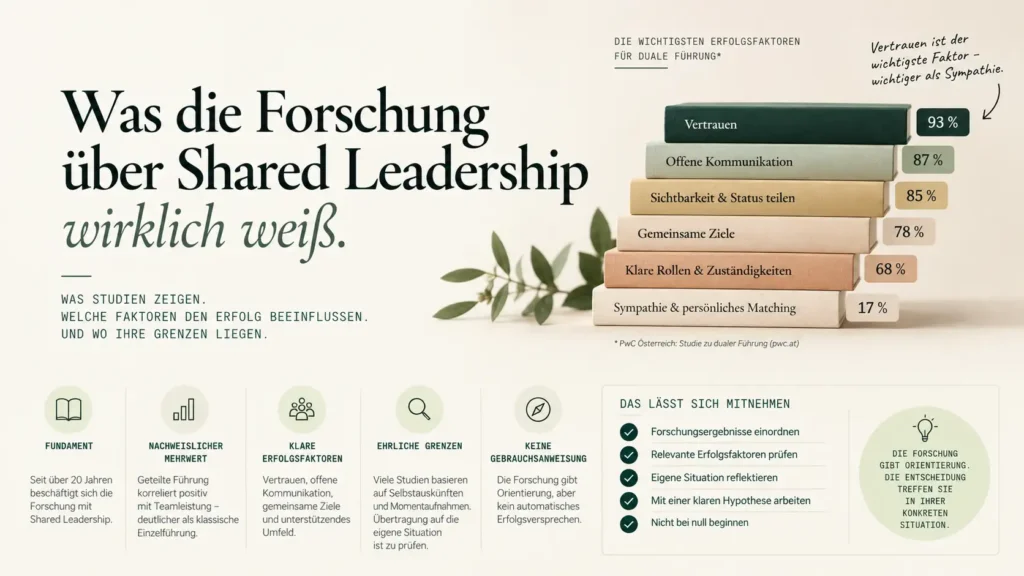
Shared leadership is often presented as a new response to the modern world of work. In reality, researchers have been studying it for more than two decades. That is reassuring and sobering at the same time. The studies offer no simple instruction manual, much less a promise that two people will automatically lead better than one.
What they do offer is more valuable: a robust picture of the conditions under which shared leadership is more likely to work. Trust, communication, common goals and a supportive environment appear repeatedly. Research cannot make the decision for your particular situation. But it means you do not have to start from scratch.
In 2003, Pearce and Conger laid the conceptual groundwork with their edited volume: leadership as a distributed process of influence rather than a quality of one individual. In 2007, Carson, Tesluk and Marrone explored the conditions under which shared leadership emerges in teams at all. And in 2014, Wang, Waldman and Zhang drew the clearest conclusion so far from a meta-analysis of dozens of individual studies: shared leadership is positively correlated with team performance, more strongly than traditional individual leadership in comparable contexts.
An Austrian PwC study went further and even assigned quantitative weights to the success factors for dual leadership:
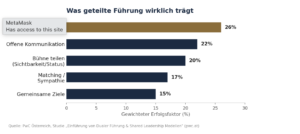
The most surprising finding is not that trust tops the list. Everyone would have expected that. It is what comes last: liking one another and personal compatibility, the idea that ‘the two simply get along’, carries the lowest weight at 17 percent. Open communication, sharing visibility and status, and common goals matter more. Personal chemistry helps. But it cannot carry the model.
For all this clarity, the research has limitations. Many studies in this field rely on self-reported information collected at one point in time, rather than long-term observation. That does not invalidate the findings. It simply means that ‘research shows’ should always be followed by ‘and we will work out together whether it applies to your situation’, rather than a full stop.
‘Research does not tell me what will work in your organisation. But it tells me what to look out for as we find out together.’
— Amrit Rescheneder (suggested quote, please review/adapt)
Something you can take away immediately: Ask yourself and your co-lead honestly: Do we trust each other even when things become uncomfortable, not just when they are easy? According to the research, this is the single most important factor, more important than personal chemistry.
Sources: Pearce & Conger (2003), Sage; Carson, Tesluk & Marrone (2007), Academy of Management Journal, 50(5); Wang, Waldman & Zhang (2014), Journal of Applied Psychology, 99(2); PwC Austria, study on dual leadership (pwc.at).