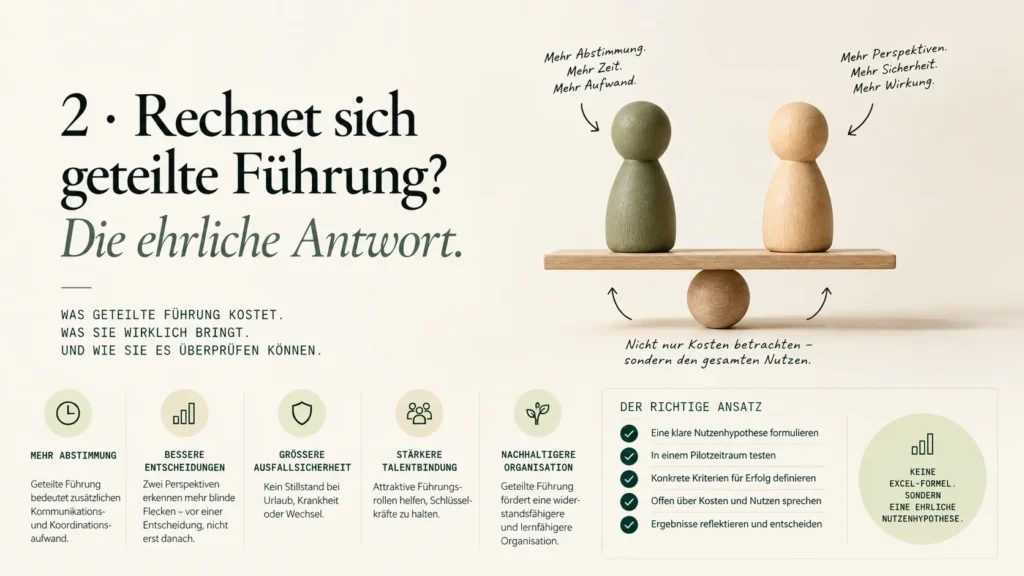
Instead, an honest calculation has two sides.
The costs are real
Shared leadership shifts effort towards coordination. Research describes this soberly as ‘high demands on coordination and communication that go beyond traditional individual leadership’. This is no minor detail. It is real, recurring time that must be planned for, not optimised away.
The benefits are real, but harder to quantify
Two perspectives can identify more blind spots before a decision is made, rather than only afterwards. Greater resilience means no standstill during holidays, illness or transitions. More attractive leadership roles also have a measurable effect on retention, especially among the people organisations find hardest to replace.
Two out of two perspectives on each decision, rather than one: that is the structural heart of the value proposition.
So the serious answer to ‘Does it pay off?’ is not a number but a method: a hypothesis about the benefits that you develop together and then genuinely test during a limited pilot period, rather than simply accepting or rejecting it.
‘I don’t sell anyone an Excel formula that doesn’t exist. What I offer is an honest hypothesis about the benefits, and the willingness to test it.’ — Amrit Rescheneder
Something you can take away immediately: Put your own benefit hypothesis into one sentence before discussing the budget. For example: ‘We expect fewer stalled decisions when the person in role X is absent.’ One sentence that you can actually test after 90 days is worth more than any number estimated in advance.
Sources: Münderlein, C. (2021). Organisationsberatung, Supervision, Coaching, 28(2); Carson, Tesluk & Marrone (2007), Academy of Management Journal, 50(5).