1 · The moment two leaders become two camps

It rarely starts with a major argument. More often it is a glance during a regular meeting, a decision that suddenly has to be explained twice, or a team member cautiously asking: Which of you actually makes that decision? Just a few months ago, leading together felt like a fresh start. Now a gap is opening between two capable people, and the organisation is beginning to feel it.
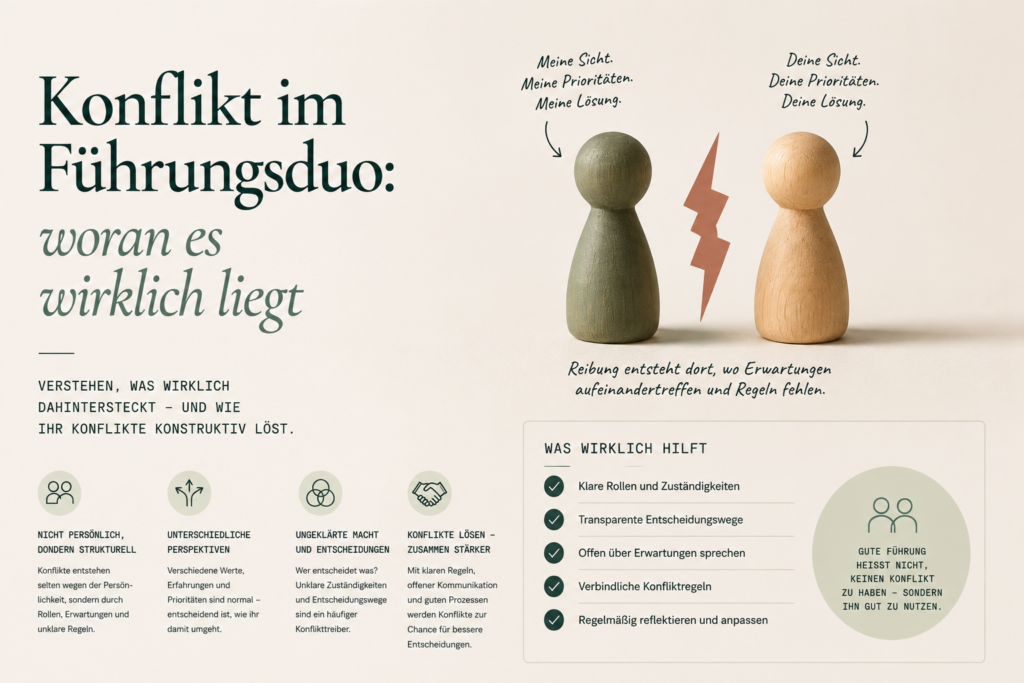
This is precisely where it becomes clear why shared leadership is about more than good chemistry. Two strong personalities do not automatically make a strong leadership tandem. What matters is whether they shape their roles, decisions and shared presence in a way that keeps things clear even under pressure. The most common reasons for failure are therefore surprisingly rarely personal weaknesses. More often, they are things that could have been settled in advance.
Scenes like this explain why “two bosses never work” is still treated as conventional wisdom, even though successful counterexamples have existed for years. Scientific evidence on leadership tandems remains comparatively limited, but coaching and organisational research reveals recurring patterns in why dual leadership arrangements unravel. Five appear most often.
01 – Poor fit – Complementary professional skills do not necessarily make for a sustainable partnership. Research gives personal and professional compatibility between the two people more weight than complementary competencies alone.
02 – Roles that exist only verbally – Clear responsibilities, combined with sufficient flexibility for day-to-day work, prevent rigid roles. When both are missing, chance or the loudest voice ultimately decides who is responsible.
03 – No visible added value for either side – Dual leadership needs a tangible value proposition, both for the two individuals and for the organisation. Without it, the arrangement eventually feels like a detour rather than a solution.
04 – Too little care in selection and implementation – Anyone who puts a tandem together simply “because it happens to work right now”, rather than deliberately assessing and introducing it, shifts the effort from preparation into crisis management.
05 – Third parties without ground rules – Employees, the board, external stakeholders: if there are no agreed rules for how the tandem presents itself externally, factions and rumours emerge. That can quickly become a serious crisis for the whole organisation.
What stands out about this list is that not one point says “the two simply didn’t like each other”. Almost all are structural and procedural issues, which can be resolved before they become problems but are much harder to fix afterwards.
“Most dual leadership arrangements don’t fail because of the people involved, but because the architecture around them is missing.”
— Amrit Rescheneder (suggested quote, please review/adapt)
Something you can do this week: Sit down with your co-lead for 15 minutes and answer this question together: Which of our responsibilities have only been agreed verbally and not put in writing? That is the quickest way to remove the second issue from your own day-to-day work.
Sources: Münderlein, C. (2021). Doppelspitzen: Notlösung, Heilsbringer oder innovatives Führungsmodell? Organisationsberatung, Supervision, Coaching, 28(2), 255–272.